Team
Service Design · UI/UX · Interaction Design
Role
Designer
Duration
1 month
Tools & Technologies
Figma
Framer
Maze
WHERE IT ALL BEGAN
Mumbai’s monsoons are familiar — waterlogged streets, overflowing drains and infrastructure struggling to keep up. But when something goes wrong beneath the surface, we often notice it only once the problem has already reached the street.
And that’s where I started looking closer.
Mumbai’s identified flooding spots have grown more than twelvefold since 2014.
Reporting of infrastructure problems still relies heavily on people noticing and flagging them before action can begin.
Mapping the system
Mumbai’s monsoons are familiar — waterlogged streets, overflowing drains and infrastructure struggling to keep up. But when something goes wrong beneath the surface, we often notice it only once the problem has already reached the street.
And that’s where I started looking closer.
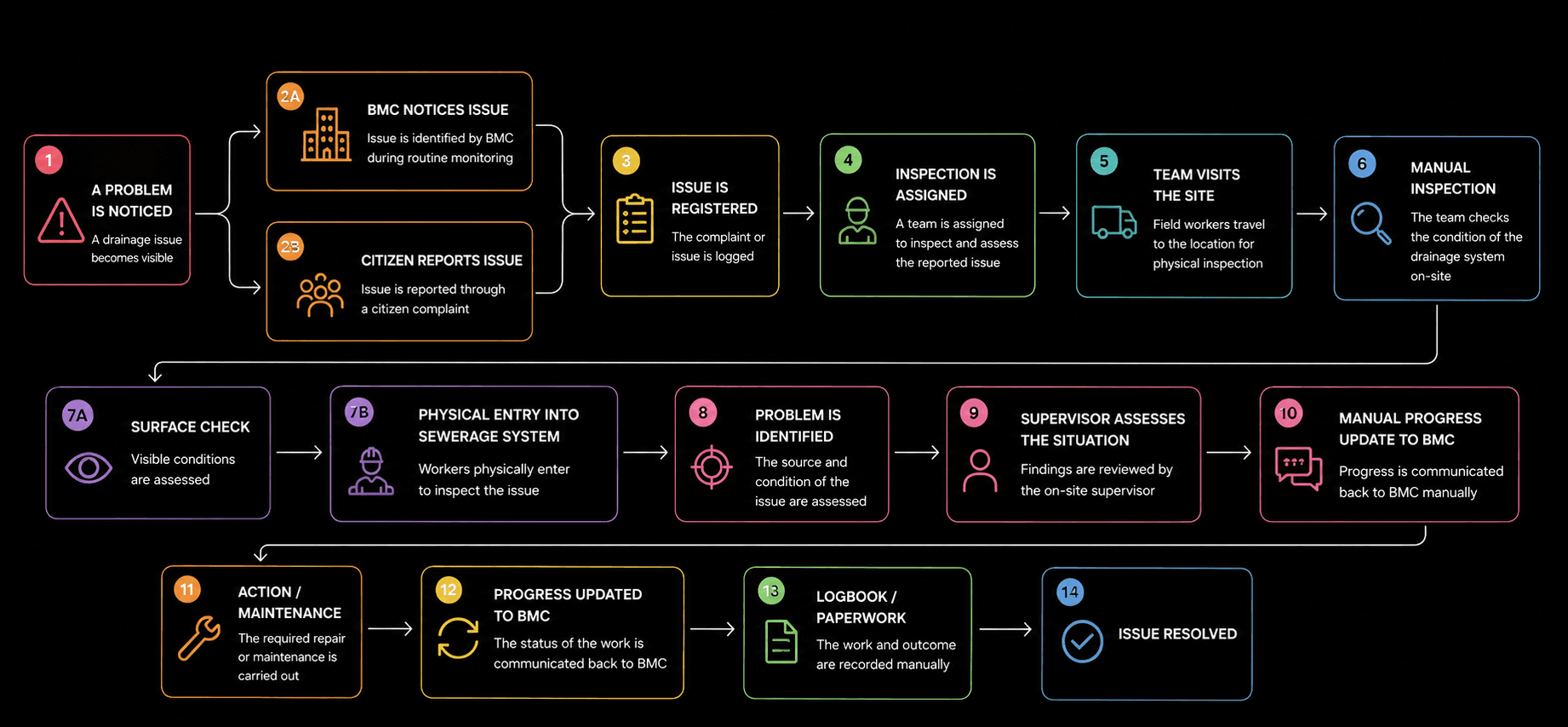
Breaking down the process — tracing where the system falls short.
Field Study
I owned the full UX redesign — user research, flow mapping, high-fidelity prototyping in Framer, micro-interaction design, and working with the engineering team to spec every interaction for production.


Key gaps
Onboarding completion rate went from 38% to 84% in 4 weeks of launch
Before inspection, there is limited visibility into what is happening underground.
Workers may enter sewerage systems without knowing the conditions they will encounter inside.
Findings and progress rely heavily on manual communication with BMC.
With fragmented updates and paperwork, progress and accountability are difficult to track.
Problem Statement
Introducing DrainGuard
From a reactive system to a connected one.
DrainGuard is a connected sewage monitoring system that enables earlier issue detection, safer field inspections, and smoother communication between workers, supervisors, and BMC.
What shipped
A completely rebuilt onboarding flow — 3 mandatory steps instead of 7, a value demonstration before any integration requests, and smooth transitions between every state.
The prototype was so close to production that engineering said it was the smoothest handoff they'd ever had.
Onboarding completion rate went from 38% to 84% within 4 weeks of the new flow going live. The team also reported a significant drop in support tickets about setup confusion in the first two weeks post-launch.
What worked
Watching session recordings before redesigning — showed the real problem instantly, no guessing. Prototyping every state in Framer — engineering had zero ambiguity during build. Moving value demonstration to step one — the single biggest lever on completion rate.
What I'd Do Differently
Test the prototype with real users before handing to engineering — caught one confusing step only after launch. Set up a more granular funnel tracking from day one to measure each step individually. Explore a more personalised onboarding path for different user types earlier in the process.
// Other works
Have a look at my other work

Drain Guard
1 month
2026
Ever wondered what if India’s sewage system could be smart? To tackle monsoon-related drainage hazards, designed a connected solution combining IoT, physical product design and digital interfaces.
Nandini Inani ( thats me ;) ) Fariya Hasan . Deshna Deora
Research · UX/UI · System Design

The Office Hours
1 month
2025
What happens when “I’ll do it later” becomes a habit? Designed a board game for ages 7–15 that explores procrastination through playful choices and consequences.
Behavioural Design · Game Design · Experience Design
Design engineer